

Maggot infestation in my worm farm! How can I get rid of them?
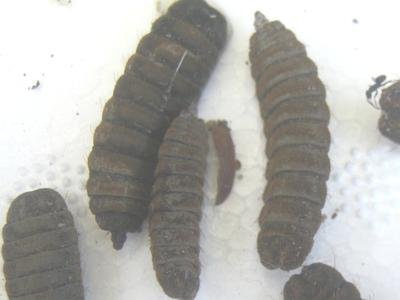
Most likely these are black soldier fly larvae. Pick out as many as you can, remove any rotting mess, then stop flies laying eggs by burying the food and covering the whole surface with a thick layer of dry shredded paper.
Maggots in a dog-poop worm bucket? See also: Help there are maggots in my worm bin! →
What to do, step by step
- 1. Identify the type of maggot.
Black soldier fly larvae
Bigger, flattened and segmented with a tough, leathery skin. Beige to grey-brown, darker when older. They often feed together in a wriggling mass on the surface. The adult is a slim black fly that looks a bit like a wasp.
Housefly maggots
Smaller, soft and creamy white, pointed at the head end and blunt at the back. Usually found on smelly, exposed food such as meat, dairy or pet waste.
Fruit-fly larvae
Tiny, thin and white, in very wet, fermenting fruit. You usually notice the small flies hovering over the bin first.
Not sure? Take a clear close-up photo and send it to Stephan.
- 2. Remove or reduce them.
Wear gloves. Lift the maggots off the surface, where they gather, into a small container, taking care not to scoop up worms. Then either pour boiling water over them and, once cooled, return them to the bin as worm food, or add them to a compost heap or feed them to chickens or fish. Take out any rotting, slimy food and mix in dry shredded paper or cardboard to soak up excess wetness.
- 3. Prevent them coming back.
- Bury the food a few centimetres / about an inch under the bedding. Never leave it on top.
- Cover the whole surface with bedding: at least 5 cm / 2 inches of dry shredded paper (or a full sheet of wet newspaper) with no gaps where flies can slip in.
- Avoid meat, fish and dairy, and go easy on very ripe fruit.
- Balance the moisture: bedding should feel like a wrung-out sponge. If it is soggy, add dry bedding and feed less.
- Keep flies out: close the lid, cover air holes with fine mesh, and keep your kitchen scrap container closed.
Hi Stephan – […] I am having a problem with maggot infestations in the worm farm resulting
in the worms dying and the vege matter turning into a revolting rotting
mess ;-(
I only put vege matter and maybe the odd stale bread slice in the unit
I scrubbed the unit twice since the previous infestation and left it in the
sun for a couple of days to try get rid of any eggs present still no luck
the maggots came back after about 2/3 weeks with the new batch of worms
any ideas on how to get rid of this ?
thanks
URSULA
Hello Ursula,
I am sorry to hear about your problem. Although you didn’t send a picture of the maggots in your worm farm I am pretty sure that you are having in infestation of Black soldier fly maggots in your worm farm.
Although they are actually great to recycle kitchen scraps and other organic waste as well they tend to take over a worm farm and the worms usually flee to the lower parts of their worm bin and sooner or later the worms either die or leave the bin and the whole worm farm turns into a smelly sludge.
The black soldier flies are attracted by decomposing fruit and vegetables that are easy accessible.
There are a few precautions you can take to prevent the soldier flies from laying their eggs into your worm farm.
– Cover the surface of your worm bin with a sheet of bubble wrap and a 2 inch / 5 cm layer of shredded newspaper. Make sure the bubble wrap is s covering all the worm food and than cover it with the shredded newspaper. The newspaper and the bubble wrap act as a natural barrier against flies and solder flies, allow worms which dislike light to feed right on top of their food layer. The bubble wrap acts as an additional protection against unwanted invaders and keeps the bedding of the worm farm longer moist.
To save your worms and your worm farm, once a worm bin is infested with solder fly maggots, do the following.
– Remove all the maggots you can see from the worm farm and place them in a bucket or any small container without a lid. It is usually quite easy to spot the maggots as most of them are feeding frantically together on the surface of the worm farm. You can then either add them to a compost heap, feed them to fish or chickens or leave them in the container for some time on a bright sunny day.
When the maggots are dead, you can discard them or add them to a compost heap.
We have many worm farms on our premises but hardly ever had problems with BSF maggots.
I trust this will help. All the best and happy worming
Kind regards
Stephan Kloppert
Author of “How to start a profitable worm business on a shoestring budget”
Editor of
www.worm-composting-help.com
Reader comments (archive) 12 comments as originally published · comments are closed
I really appreciate this info.
I went out this morning & found a patch of these
I hadn’t opened the lid for 2 days & there they were! I felt ill!!! About a week ago I did have the lid opened for a while because I was stirring the bed so I guess they got in then? So I’ll be following your great advice about how to take care of maggots in a worm farm. Thank you!!!
Hello Salt,
the good news is that white maggots apart from being a bit of a pest are usually not directly harmful to a worm herd inside a worm bin.
However, they are in most cases usually the maggots of flies.
What we usually do to get rid of them is to collect them from the surface of the bin where they mostly congregate, place them in a small container and pour boiling water over them. Once they are dead and the water has cooled down we usually add them back to the worm bin as they then serve as worm food.
A good way to prevent flies from laying eggs in your worm bin is to block their access to the worm food that attracts them.
A nice layer of dry shredded paper (at least 5cm / 2 inches thick) covering the surface of your worm bin works usually quite well.
I trust this will help you solve your problem
Kind regards, health and blessings for you and your family.
Stephan Kloppert
Author of “How to start a profitable worm bin on a shoestring budget”
Editor of www.worm-composting-help.com
i have white maggots in my worm bin and not soldier maggots as i know what they look like my problem is the white maggots and how to prevent them or to eliminate them i had one tote and they took over the worm population
I started noticing tiny white maggots inside my worm bin today. For a few days I’ve been digging into the worm bin and haven’t seen any worm (I released quite a few about a month ago and usually find one or two worms). I have a huge bin that actually is a 15 gallons or so (my guess) black plastic pot. There’s no cover on it but I thought it’s safe and well covered since I put it inside the greenhouse.
From discussions above, I’m guessing the worms may have moved under the bin (?). Yet I’m too lazy to take them out. I’m thinking about getting new worms to populate the bin. Do you think it’s a good idea? Will worms live well alongside existing maggots? Will they eat the maggots or end up being pushed aside by maggot colony and eventually die?
I have both white and red/brown maggots. I just noticed them yesterday and keep turning the goo and pulling out and tossing them into the sun. I put a fine screen over it and a 1/4 in. screen on top of that to hold it down. I put some brown paper in to soak up the wet and will lay some on top, to absorb the wet.I didn’t know about black maggots. I’ll look out for them. Are they much different? Should I keep up what I’m doing or pull my worm friends out and start over?
Hello Genevieve,
thank you for the compliments. It is always be nice to get some good feedback for all the hard work that went into this Website.
To answer your question. The way I understand you your worm bin has been invaded by Black Soldier Fly maggots!?
In that case I would not wait but rather remove all or at least as many of them as you can to avoid the risk of loosing all your worms.
Here are a few more articles of mine that should help you to deal with the problem of maggot infestation in your worm bin.
https://www.worm-composting-help.com/soldier-fly-maggots-in-my-worm-farm.html
https://www.worm-composting-help.com/black-soldier-fly-larva-infested-my-worm-bin.html
https://www.worm-composting-help.com/Maggots-in-a-worm-farm.html
I hope this will help you.
Let me know if you where successful or need any other advise about your worms?
Kind regards
Stephan Kloppert
Author of “How to start a profitable worm bin on a shoestring budget”
Editor of www.worm-composting-help.com
This has been extremely helpful as we figure out our own worm bin.
We have some maggots and I was wondering about how long it might take for the maggots to negatively affect the worms eating.
I was reading the paragraph, ” […] and the worms usually flee to the lower parts of their worm bin and sooner or later the worms either die or leave the bin and the whole worm farm turns into a smelly sludge.” from Stephan Kloppert.
I know this is probably a hard question to answer without seeing our actual bin, but we are using a Roughneck 18 gallon Rubbermaid Storage Box and have kept in inside our porch until the fruit flies became a nuisance and we moved it outside.
I am thankful for your post as we will be covering our air holes with Mesh and letting the soil dry out some. We might also try out the wet newspaper and plastic suggestion.
Would you suggest IMMEDIATELY excavating the maggots or do you think they can be helpful for a few days to a few weeks in helping compost our food scraps without killing our worms because they are moving to the bottom of the bin and not eating?
Thank you for this website and excellent information,
Genevieve
Hi TK thank you for your interesting comment. Can you please send us a picture of the maggots you found in your composter and maybe a picture that shows how a maggot is actually feeding on an earthworm?
The only maggots that I know of that are actively recycling organic materials are Black soldier fly maggots. However although compost worms don’t like to be close to them I have never seen a worm being eaten by the maggots. I do agree that BSF maggots are recycling organic mater quite fast. They don’t like all organic materials presented to them and the compost they leave behind becomes usually soggy and quite smelly contrary to worm castings from a well run worm farm that are basically odorless.
That’s one of the reasons that I mostly rather stick with worm composting than working with BSF maggots.
But as I mentioned above please send us some more information about the maggots in your composter and the finished compost they produce. I am sure it would be very informative for our community.
Kind regards
Stephan Kloppert
Author of “How to start a profitable worm business on a shoestring budget”
Editor of www.worm-composting-help.com
I was horrified to see my hundreds of earthworms being devoured by the maggots in my closed compostor. Amazingly, the maggots we’re far more efficient and expedient in breaking down the wide variety of material I added daily. I chose to go with it, and had a far more successful breakdown of material. I’ll not contest it this year !!!
Hi Vanessa, can you please send me a picture of the worm bin and a close up of the maggots and a little more information so I can get a better idea and can assist you better. What did you feed them and how moist is your worm bedding? Kind regards
Stephan
Hello Stephen
i have a worm bed but the white maggots keep taking over…please advise
thanks
Hi Stephan – you are exactly right – I did notice a lot of small black
almost beetle like insects in the farm so that must be it
The farm I have consists of round plastic units about 3in deep and quite a
secure lid with only small disc areas for ‘breathing holes” but I guess
they must be small enough for small fly’s to access.
or what might be happening is the fly’s laying eggs in the open container I
keep in the kitchen which then is transferred to the farm 2x a week.
either way I will take up your suggestions and start again
many thanks & kind regards
URSULA
This is an archive of the comments from the original page. Links in older comments point to pages that have since moved. Questions? Ask Stephan.