

DIY flow-through worm bin (FTWB): how it works and how to build one
In a flow-through bin you add food and bedding on top and harvest finished castings from the bottom through a mesh or bars, so you never have to empty the bin or separate worms by hand. It is the bin for larger amounts of waste, for example manure from rabbits.
Flow-through bins (also called continuous flow-through, CFT) are one of my favourite designs. A reader, Mark Ferguson, once sent in his commercial-size flow-through bin: he fed it rabbit manure and harvested with a home-made “casting chainsaw” instead of standing the bin on a concrete slab. His website is no longer online, so this page explains the principle and a simple build that anyone can copy.
How do I build a simple flow-through worm bin?
- Frame: build an open box on legs of wood or use a large plastic drum with the bottom cut out. Leave 30–50 cm of space underneath for harvesting.
- Floor: about 20–30 cm above the bottom, fix metal bars or rods about 5 cm apart, or strong mesh with openings of 1–2 cm.
- Starter layer: lay a few sheets of newspaper or cardboard on the floor, then 10–15 cm of moist bedding.
- Worms and food: add the worms, then feed thin layers on top, each time with a little fresh bedding.
- Cover: a lid or sack keeps moisture in and light out.
How do I harvest from the bottom?
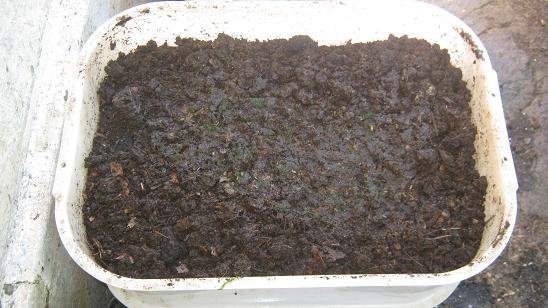
Wait until the bin is well filled, usually after a few months. Then scrape along the bars or mesh from underneath with a rake or a flat bar, and the bottom layer of castings falls through. Scrape only a few centimetres each time. The worms stay up in the fresh food. Mark’s version used a chain with small scoops, driven by a drill, that pulls the castings out the front instead.
What can go wrong?
- Too dry: flow-through bins are open at the bottom and dry out faster. Check moisture often.
- Too much food at once: thick layers heat up. Feed thin layers.
- Harvesting too early brings out worms and unfinished material.
- Cold: Compost worms cope with about 5–29 °C (41–84.2 °F), and they do best at 15–25 °C (59–77 °F). In winter, insulate the sides or keep the bin in a shed.
Is a flow-through bin right for me?
If you have a small household, a 2-bucket bin or a 3-tier bin is easier. A flow-through bin pays off when you have lots of manure or garden waste, or several bins to harvest.
Running your worm farm as a business? How to Start a Profitable Worm Business on a Shoestring Budget shows you the way.
Happy worming!
Stephan Kloppert
Nearly 30 years of worm farming in South Africa and Germany