

Maggots in a worm farm: which ones are harmful?
There are four kinds of maggot you’re likely to find. Black soldier fly larvae drive worms out, so remove them quickly. Beetle grubs are usually harmless. House fly maggots breed fast, so remove them and keep meat, fish and dog poop out of the bin or well covered. Fruit fly maggots are tiny and harmless to worms, a sign of exposed fruit and a bin that’s too wet.
Sooner or later, most worm farmers lift the lid and find maggots wriggling between their worms. Don’t panic. Whether you need to act depends on which maggot it is. There are four kinds you’re likely to meet, and this page helps you identify them. To get rid of flies and maggots, read the companion page how to get rid of maggots and flies in my worm bin.
- What kinds of maggots turn up in worm farms?
- Are black soldier fly larvae harmful to my worms?
- What should I do about black soldier fly larvae?
- Are beetle grubs a problem?
- Why are house fly maggots the biggest headache?
- What are the tiny white maggots in the fruit scraps?
- How do I keep flies and maggots out for good?
What kinds of maggots turn up in worm farms?
Over the years I’ve found four kinds in my worm farms:
- Black soldier fly larvae (Hermetia illucens)
- Beetle grubs, for example of the African fruit beetle
- House fly maggots and those of their close relatives
- Fruit fly maggots (Drosophila)
Most other creatures in a mature bin, such as springtails and woodlice, are harmless helpers. A few, like centipedes and slugs, do eat worms, but the losses are usually small.
Are black soldier fly larvae harmful to my worms?
Not directly, as they don’t eat worms. But they’re ferocious eaters, and compost worms hate sharing their bin with them. The worms either crawl out or retreat into the bottom layers, where they can die. If you leave it, the bin can turn into a soggy, smelly mess, and in the worst case you’ll have to If your worms are fleeing into the bottom tray, see worms escaping into the bottom bin.
What should I do about black soldier fly larvae?
Remove them as soon as you see them. They usually gather near the surface, so they’re easy to pick out. We collect them and put them in a separate compost heap, or feed them to our chickens or fish. Cover the food well so the flies can’t lay new eggs. If your bin is a dog poop worm bin, see how to keep black soldier flies out of my dog poop worm bin.
Are beetle grubs a problem?
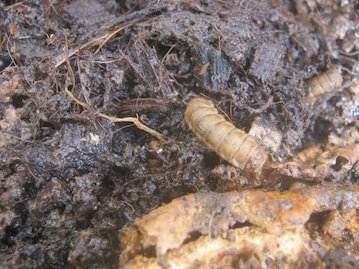
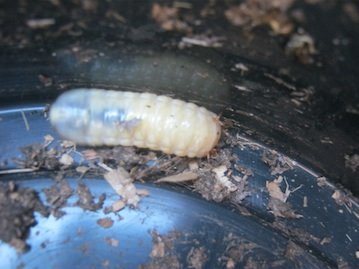
Usually not. Many beetles lay their eggs in rich organic matter, which is why their grubs turn up in compost heaps and in worm farms that beetles can get into. My worms don’t seem bothered by them, even though the grubs grow to about 5 cm / 2 in long and as thick as a man’s finger. We use them as fishing bait or feed them to the chickens. Our koi aren’t very keen on them.
Why are house fly maggots the biggest headache?
They’re only about 5 mm / ⅕ in long, but they multiply incredibly fast. House flies are drawn to blood, meat, fish and dog poop, and they can apparently smell blood from more than 8 km / 5 miles away. If you recycle any meat or fish in a worm bin, make sure flies can’t get in.
If you do find house fly maggots, scoop them into a bucket and pour boiling water over them. Once the water has cooled, bury the dead maggots in a trench in the bedding. They become good worm food.
What are the tiny white maggots in the fruit scraps?
Those are almost always fruit fly maggots. They’re much smaller than house fly maggots, only about 3–4 mm / ⅛ in long when fully grown. They’re slender, white to cream and see-through, with a pointed head end and a tiny black mouth hook. You’ll find them in the top few centimetres, crowded into soft, fermenting fruit such as banana peels, pawpaw skins, melon rinds and overripe guavas. You’ll often see the adult flies there too: plump, pale brown or orange flies of 1–2 mm with slow flight and red eyes.
Are they harmful? No. Fruit fly maggots feed on the yeasts in rotting fruit and leave the worms alone, and the worms happily eat the leftovers and any dead maggots. The problem is the swarm of adult flies that hatches from them a few days later, especially in warm, humid weather.
What causes them? In most cases the eggs arrive on the fruit peels themselves, too small to see. Then too much fruit at once, food left uncovered on the surface, or a bin that is too wet and sour lets them multiply quickly.
Quick control: lift out the worst pocket of fruit and maggots, bury fresh scraps under 5 cm / 2 in of bedding or old castings, and cover the surface with a sheet of damp newspaper or sacking. Mix in dry shredded cardboard if the bin is soggy, and freeze fruit peels overnight before you feed them. Traps catch the adults that are left. My full guide is on the fruit flies in the worm farm page.
Plan your first 90 days
My Easy Worm Farming Planner walks you through setting up the bin, feeding and checking moisture and temperature week by week, and it has a log for your first three months.
See inside the Planner →How do I keep flies and maggots out for good?
Don’t overfeed. Bury the food under the bedding and keep the surface covered. Leave out meat, fish and dairy, and keep the lid tight. I’ve put the full step-by-step prevention plan on a separate page: how to get rid of maggots and flies in my worm bin.
Happy worming!
Stephan Kloppert
Nearly 30 years of worm farming in South Africa and Germany